
In machining, experience is often seen as the ultimate safeguard. Years on the shop floor, thousands of cycles, and a deep familiarity with machines create confidence, and rightly so. But confidence, over time, can quietly turn into comfort. And comfort is where risk begins to creep in.
Recently, a machinist with 18 years of experience shared a moment that reinforces something we think about constantly when designing our machines.
A Real-World Reminder
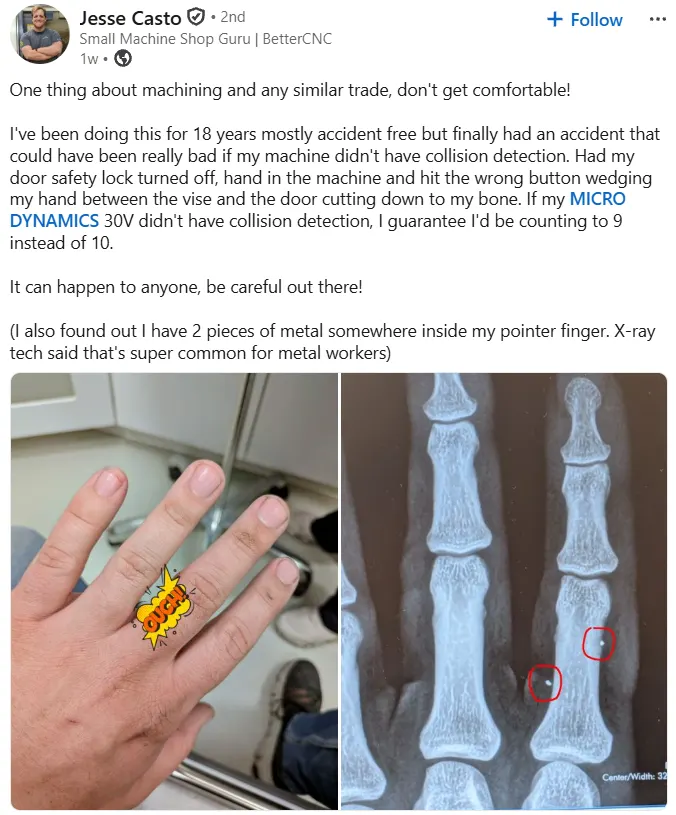
This isn’t a story about inexperience. It’s the opposite. It’s a reminder that even highly experienced operators can have a split-second lapse: a wrong button press, a bypassed safety lock, a moment of distraction.
Machines do exactly what they’re told. No second-guesses.
That’s why systems like collision detection exist.
Designing for Reality, Not Perfection
In real shop environments, operators work under pressure. Deadlines, repetition, and familiarity all shape behavior. Over time, small shortcuts appear, not out of negligence, but out of efficiency.
The issue is that CNC machines operate with force, speed, and precision. When something goes wrong, it happens instantly.
Designing machines around perfect behavior is unrealistic. Designing them to respond to imperfect behavior is essential.
What Collision Detection Actually Does
Collision detection is an active, real-time monitoring system built into the control layer of the machine.
It continuously evaluates motor load across all axes. Under normal conditions, load follows a predictable pattern, increasing during acceleration, stabilizing during motion, and spiking again during deceleration.
The system filters these expected behaviors.
When load exceeds what is considered normal for that axis, based on calibrated thresholds, the system identifies it as a collision condition and immediately stops the machine across all axes.
This response happens before force continues to build.
Parameter Control: How the System Is Tuned
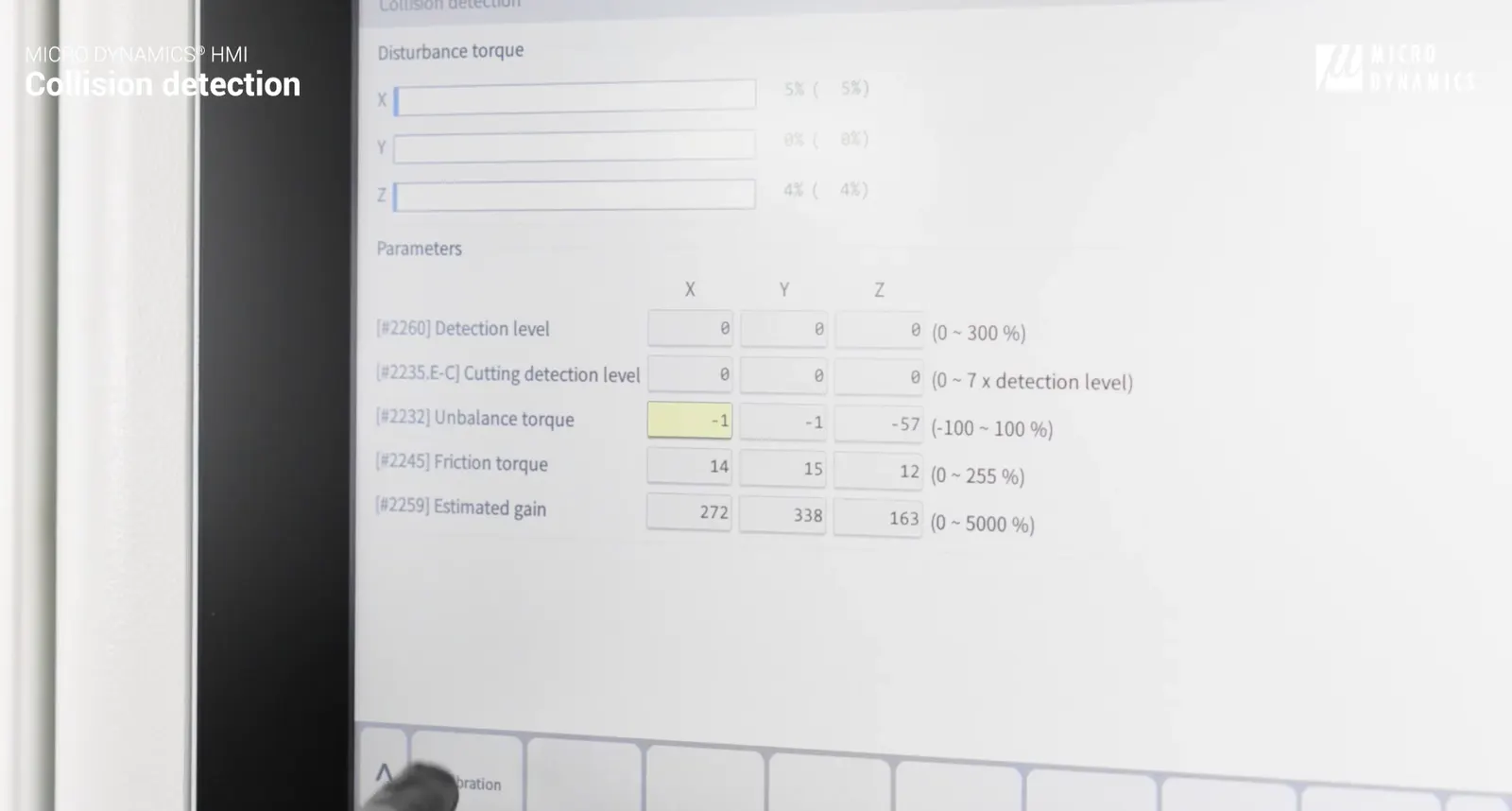
Collision detection is not a fixed, one-size-fits-all function. It is adjustable per axis (X, Y, and Z), allowing the system to be tuned based on machine dynamics, tooling, and application.
Each axis can be configured with the following parameters:
Detection Level (0–300%) Defines the base sensitivity of the system. Lower values increase sensitivity; higher values allow more load before triggering.
Cutting Detection Level (0–7× Detection Level) Allows higher permissible loads during cutting operations, preventing false positives while maintaining protection during aggressive machining.
Unbalance Torque (-100% to +100%) Compensates for asymmetrical loads or mechanical bias in the axis, ensuring detection remains accurate under uneven conditions.
Friction Torque (0–255%) Accounts for baseline mechanical resistance in the system, helping distinguish normal friction from abnormal load spikes.
Estimated Gain (0–5000%) Adjusts the responsiveness of the detection system, influencing how quickly load deviations are interpreted and acted upon.
These parameters work together to create a detection model that reflects the real behavior of the machine, not just theoretical limits.
In addition, automatic calibration tools within the HMI establish baseline values for each axis, allowing operators to fine-tune without complex manual setup.
What Happens Without It
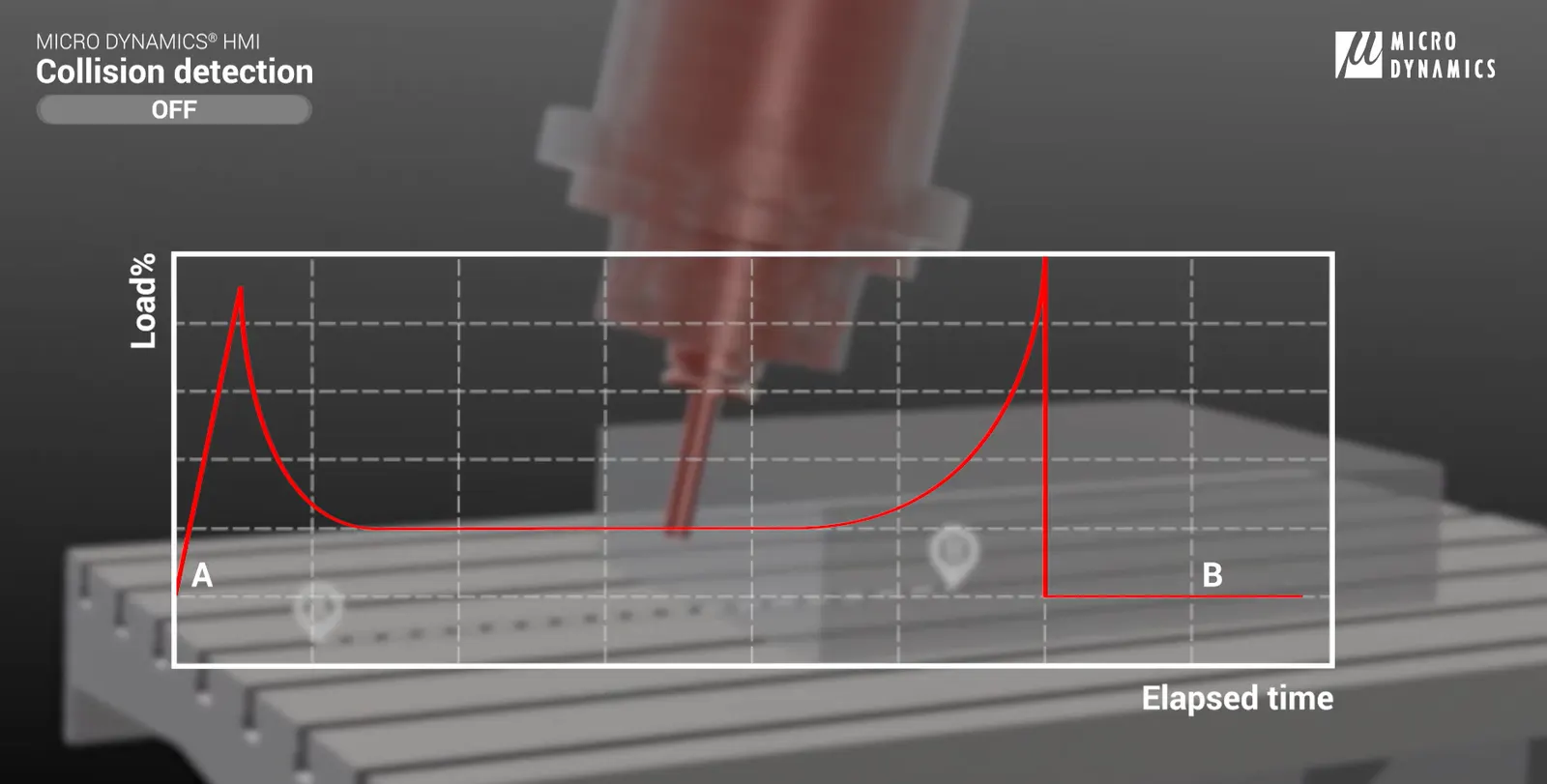
Without collision detection, the machine continues executing commands regardless of resistance.
If an obstruction is present, the servo system increases torque to reach the commanded position. Load rises, force builds, and the system only stops after mechanical or electrical limits are exceeded.
By that point, damage has already occurred.
What Changes With It
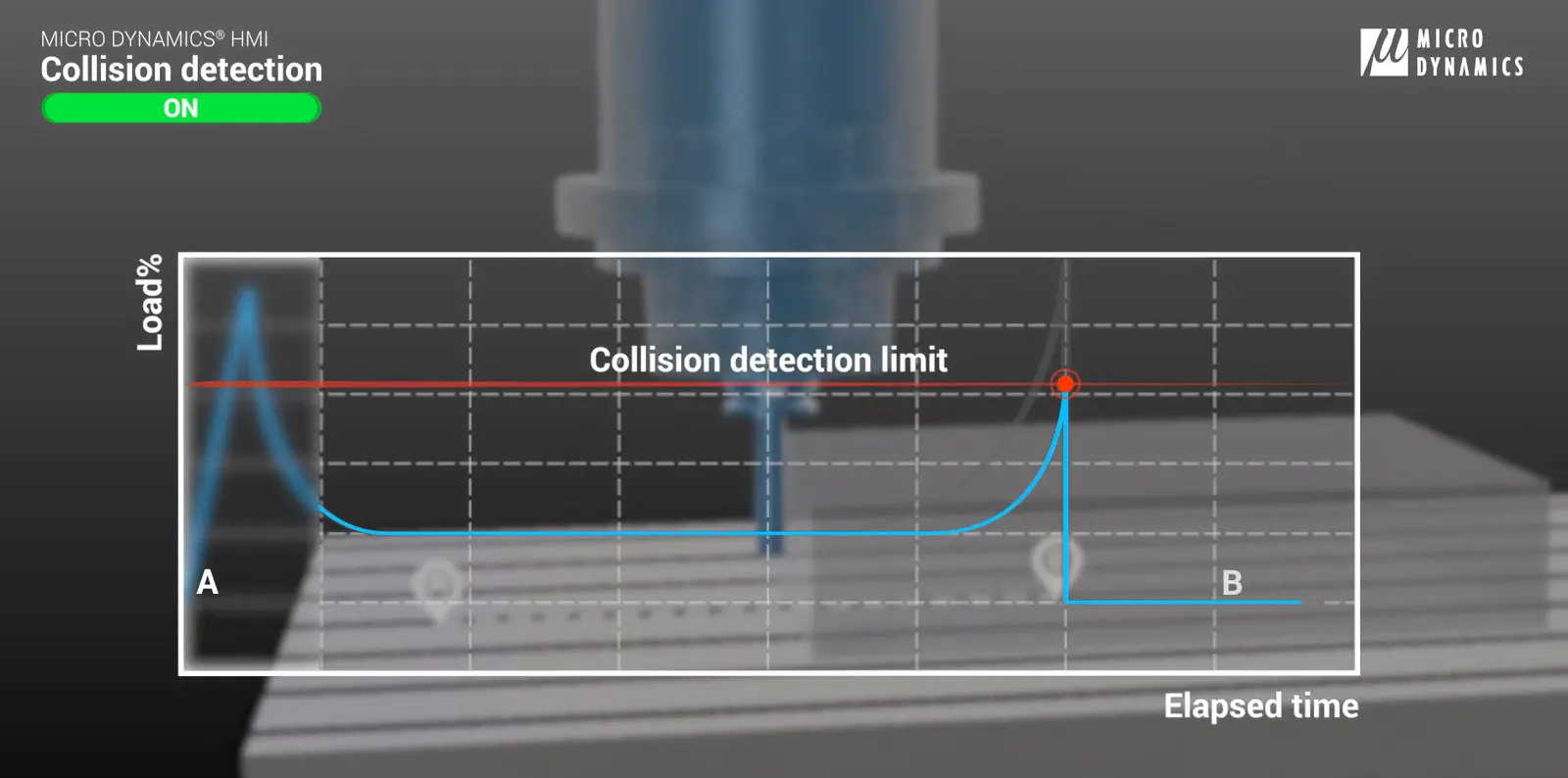
With collision detection properly configured, the machine behaves differently under the same conditions.
Instead of forcing movement, it recognizes abnormal resistance early and halts motion immediately. This prevents escalation, protecting the spindle, tooling, and workpiece.
More importantly, it protects the operator.
In the case shared earlier, that immediate response is what prevented a far more serious injury.
Why We Made It Standard
Collision detection is not optional. It is built into every vertical machining center we produce.
This is intentional.
Safety systems that depend on being enabled, configured, or remembered are not reliable in real-world environments. By integrating collision detection directly into the control system, and supporting it with automatic calibration, we ensure it is always active and usable.
A More Honest View of Safety
Safety in machining is often framed around procedures and discipline. Those are critical, but they are not enough on their own.
Machines must also be designed to respond intelligently when something goes wrong.
Human error cannot be eliminated. But its consequences can be controlled.
Final Thought
The takeaway isn’t just about a feature. It’s about acknowledging reality.
Even after years of experience, risk never fully disappears.
The difference between a close call and a life-changing injury often comes down to how quickly a machine can react.
Collision detection ensures that when something goes wrong, the machine doesn’t make it worse.