
Solving the oldest CNC bottleneck
Automatic pallet changers are no longer niche automation. They are one of the most practical ways to reduce one of the oldest CNC bottlenecks: precious spindle time lost to loading, unloading and resetting work. In simple terms, a CNC automatic pallet changer lets one pallet be machined while the next pallet is prepared outside the cutting zone. That is why so many buyers search variations of the same questions: what is an APC, how does it work and does it genuinely improve throughput?
The Solution
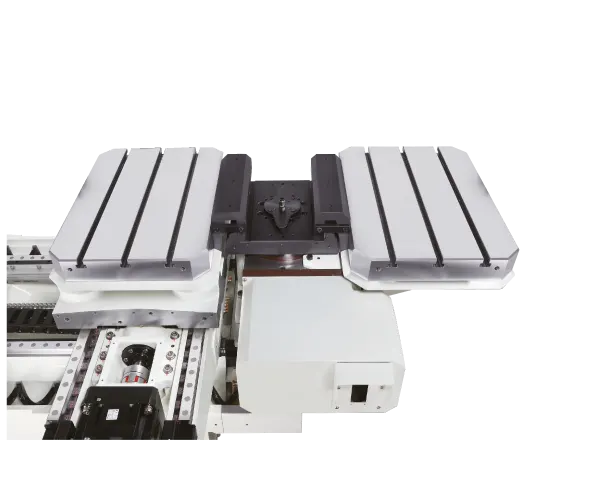
The MEGA 20VAPC answers those questions with a clear production-first design. Its specification centers on a dual servo-driven pallet changer that switches in 8.5 seconds, using 560 × 400 mm pallets with 200 kg capacity per pallet. Around that APC platform, the machine delivers 600 mm X travel, 510 mm Y travel, 510 mm Z travel, a 40 taper dual-contact built-in spindle, 15,000 RPM standard (20,000 or 24,000 RPM optional) spindle speed, 31 kW max power, 141 Nm max cutting torque and a standard 40-tool random magazine, with optional 60- and 90-tool magazines available.
More moving parts with the same accuracy
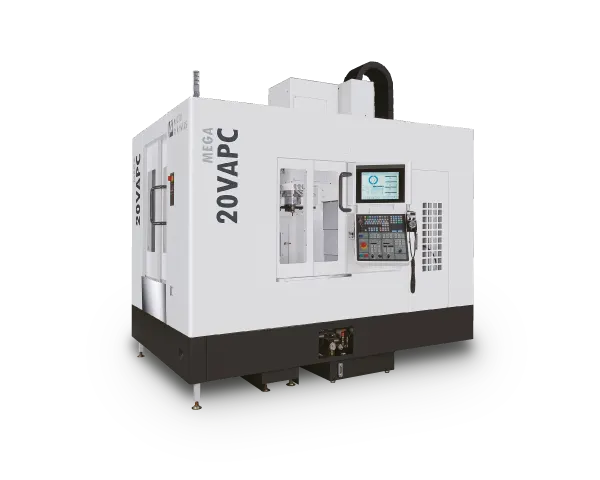
What makes the MEGA 20VAPC more than a simple speed play is the accuracy and recovery layer around it. The machine has a pallet repeatability of 0.004 mm through pressurized cones, positioning accuracy of 0.005 mm over full stroke and repeatability of ±0.0025 mm. It also pairs the pallet system with a built-in HMI environment that includes Auto Part Setup, Micro Mill, Tool Setup, File Manager, Magazine Monitor, ATC Recovery, APC Recovery, Collision Detection, DYPEC Thermal Compensation and Renishaw Set and Inspect. A pallet changer only delivers value when it can be restarted quickly, repeated accurately and trusted shift after shift.
Built for the real world
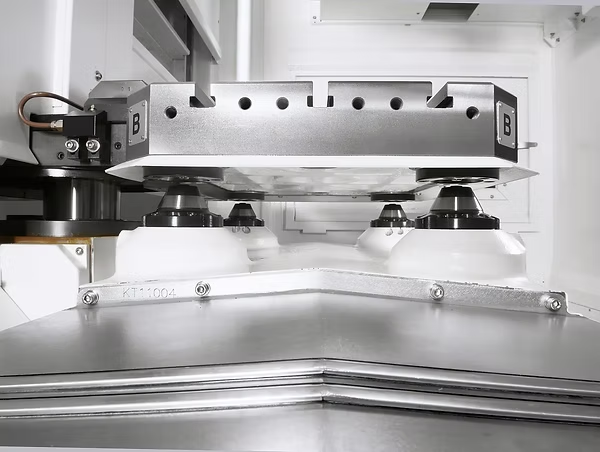
On the shop floor, the MEGA 20VAPC’s supporting systems are just as important as the pallet-swap figure. The chip-management package includes base wash, dual augers and a conveyor intended to minimize chip build-up, while triple protection covers help keep chips and contamination away from guideways, ballscrews and servo motors. The structure itself is heavily ribbed Meehanite FC300 cast iron analyzed for strength and stability, and the thermal-compensation package (DYPEC Thermal Compensation) is standard across all MICRO DYNAMICS products. This gives the MEGA 20VAPC a stronger uptime, predictability and maintenance than machines that advertise only spindle speed and tool count.
Giving you 30 extra days per year?
The core business case for an APC is non-cut time reduction. A manufacturing white paper on VMC profitability notes that average VMC spindle utilization in cut can fall to 34% even though it should be closer to 70%, largely because so much time disappears into loading, unloading, setup, chip clearing and similar interruptions. Simply put: decoupling setup from cutting and OEE improves because the spindle waits less. If your current process consumes three minutes between cycles for unloading, reloading and reclamping, and a dual-pallet process reduces the actual exchange event to 8.5 seconds while setup happens offline, you recover roughly 57 minutes per day at 20 swaps, or about 238 machine hours per year across 250 workdays. That’s 30 full working days at 8 hours per day. That is why the cleanest way to estimate MEGA 20VAPC ROI is to model recovered spindle hours against your shop rate, labor coverage and delivery gains.
Where it fits
In terms of applications, the MEGA 20VAPC fits where recurring setups constrain output more than raw cutting horsepower alone. Automatic Pallet Changers are a particularly good fit for aerospace, automotive, medical, defense and contract machining. The MEGA 20VAPC is most compelling for recurring part families, short-to-medium cycle production, first-op/second-op fixture strategies, and operator-constrained cells where the machine is often waiting for people rather than the other way round.
Easy to plan
Installation planning is also unusually concrete on the MEGA 20VAPC data: 220V/3PH, 30 kVA power consumption, 300 L/min pneumatic supply, a 300 L coolant tank, 2,561 × 2,972 mm footprint, 2,921 mm machine height and 6,400 kg net weight. Preparation and options are presented early: optional 4th-axis pre-wiring, optional 20-, 40- and 70-bar CTS packages, transformer options for 380V/415V/440V power sources, and optional automatic doors. That makes the 20VAPC easier to evaluate as a productivity upgrade rather than a dead-end capital purchase.
How you win
The simplest verdict is this: if your parts fit the published 560 × 400 mm pallet envelope and 200 kg-per-pallet load, and your business wins when setup is separated from cutting, the MEGA 20VAPC looks less like optional automation and more like controlled capacity expansion. It answers the questions we get asked most: time saving, accuracy, maintainability, compatibility and competitive fit.
Frequently Asked Questions:
What is an automatic pallet changer in CNC?
It is a system that automatically swaps one pallet of fixtures or workpieces for another, allowing the next job to be loaded offline while the current job is still cutting.
How does an APC work?
The control sends a pallet-change sequence after the machine reaches a safe state; the active pallet unclamps, the changer lifts or rotates/transfers the pallets, the next pallet seats and clamps, and machining resumes. On some controls, this is called by an M-code such as M50. In Micro Dynamics machines this is called by M-code "M60".
What is the difference between an APC and an ATC?
An APC changes pallets holding parts or fixtures; an ATC changes cutting tools. They solve different bottlenecks, and MICRO DYNAMICS machines use both.
Does a pallet changer really improve OEE and spindle utilization?
Yes, that is the main point of the technology: loading and setup happen offline, reducing non-cut time. APCs can drive large spindle-utilization gains.
Can an APC support lights-out or unattended machining?
It can support longer unattended windows by reducing manual intervention and queueing work more efficiently, but safe unattended operation still depends on fixturing, process stability and active risk management; unattended-capable still carries unmonitored process risk.
What maintenance matters most on a pallet changer?
The recurring themes are clean dry air, chip control around locating and clamping surfaces, sensor health, seals, regulators, dampers and recovery procedures. MICRO DYNAMICS machines are engineered with all of this in mind.
Buyer’s checklist
Measure how much time per shift is currently spent loading, unloading, finding offsets or waiting for prove-out rather than cutting.
Check published pallet load, work envelope and fixture height against your heaviest recurring jobs.
Confirm utilities, floor space, chip-conveyor discharge path, coolant handling and compressed-air quality before ordering.
Decide whether you need 4th-axis preparation, higher-pressure CTS, more magazine capacity or automatic doors from day one.
Recommended industries and applications
Best-fit sectors and applications include mold and toolroom work, aerospace brackets and housings, automotive production parts, semiconductor tooling and fixture plates, medical or precision OEM components, contract machining and one-operator cells running recurring part families. The strongest fit is where repeated setups consume operator time and where first-op/second-op or family-of-parts workflows can benefit from one pallet being prepared while the other is in cut.
MEGA 20VAPC FAQ:
What is the MEGA 20VAPC?
The MEGA 20VAPC is a 3-axis, 40-taper vertical machining center with a dual servo-driven automatic pallet changer designed for high-production machining.
How fast is the MEGA 20VAPC pallet change?
The pallet-change time is 8.5 seconds.
What pallet size does the 20VAPC use?
The machine has a pallet or table size of 560 × 400 mm.
How much weight can each 20VAPC pallet carry?
The maximum table load is 200 kg per pallet, with two pallets on the system.
What spindle and tool capacity does the 20VAPC offer?
A 40 taper dual-contact built-in spindle at 15,000, 20,000 or 24,000 RPM, 31 kW max power and a standard 40-tool magazine, with optional 60- and 90-tool capacities.
Is the 20VAPC suitable for lights-out machining?
It is designed to reduce manual intervention and supports APC recovery in the HMI.
What utilities does the 20VAPC require?
The utility requirements include 220V/3PH power, 30 kVA consumption and 300 L/min pneumatic supply.
Can the 20VAPC be configured for more automation or coolant options?
Yes. Options include 4th-axis pre-wiring, automatic doors, coolant ring and coolant-through-spindle packages at 20, 40 and 70 bar.
What helps the 20VAPC maintain accuracy during production?
Features that support accuracy include 0.004 mm pallet repeatability, ±0.0025 mm machine repeatability and the DYPEC thermal-compensation system.